Automatic or quartz: which movement suits how you live
24/09/2026
Two watches can look almost the same on the wrist and work in completely different ways. The difference is the movement: the engine under the dial. Most watches sold in Europe below three hundred euros run on one of two, and choosing between them is less about quality than about how you live.
Quartz: it runs whether you do or not
A quartz movement keeps time with a tiny crystal that vibrates under a small electric current. It is the most accurate mechanism in ordinary use, drifting by seconds a month rather than seconds a day, and it needs almost nothing from you. A battery every two years or so, and that is the whole relationship.
Quartz suits you if the watch will sit in a drawer for a fortnight and still be right when you pick it up. It suits a first good watch, a second watch for the weekend, and anyone who would rather not think about winding.
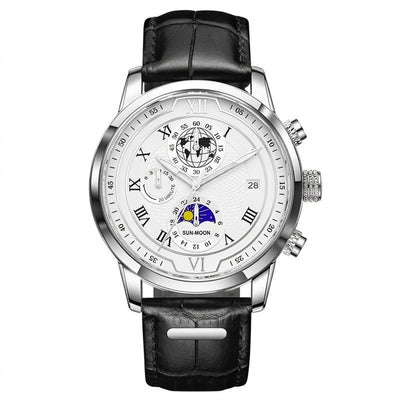
Its reputation for being the cheaper option is a leftover from the nineteen seventies. Today a quartz chronograph carries complications that a mechanical watch at the same price cannot: a second counter, a date, a sun-and-moon display that turns with the day.
Automatic: it runs on you
An automatic watch is mechanical. A weighted rotor swings as your arm moves, winds a spring, and the spring drives the hands. No battery, no electronics, and a movement that can be serviced rather than replaced.
The trade is attention. Worn daily, an automatic keeps going. Left alone for a day or two, it stops, and you set it again with a few turns of the crown. It also keeps time less precisely than quartz, typically within some seconds a day, which matters to almost nobody and bothers some people enormously.
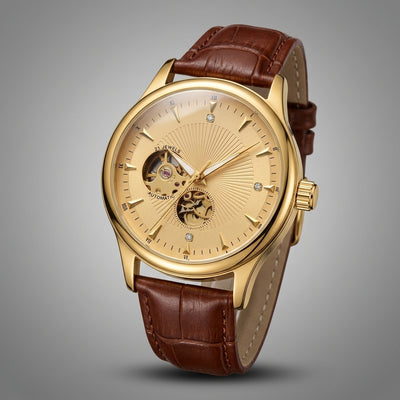
Automatic suits you if the mechanism is part of the appeal, if you like the idea of an object that needs your movement to stay alive, and if you wear the same watch most days. An open-heart dial, where a window shows the balance wheel turning, exists for exactly this reason.
Which one, in practice
| If you… | Choose |
|---|---|
| Wear a watch a few times a week | Quartz |
| Wear the same watch every day | Automatic |
| Want a date, a chronograph, a moon display | Quartz |
| Want to see the mechanism work | Automatic |
| Hate the idea of a battery | Automatic |
| Hate the idea of resetting the time | Quartz |
The honest answer
Neither is better. A quartz watch is a tool that happens to be beautiful; an automatic is a small machine you agree to look after. Most people who own both wear the quartz on the days that matter and the automatic on the days that are theirs.
At LÖWE the choice is between two collections. The Rigi is the quartz chronograph, with a sun-and-moon disc and a world-map counter. The Pilatus is the open-heart automatic, self-winding, with the balance wheel in plain sight. Both take a stainless steel case on calf leather, and both carry two years of guarantee.